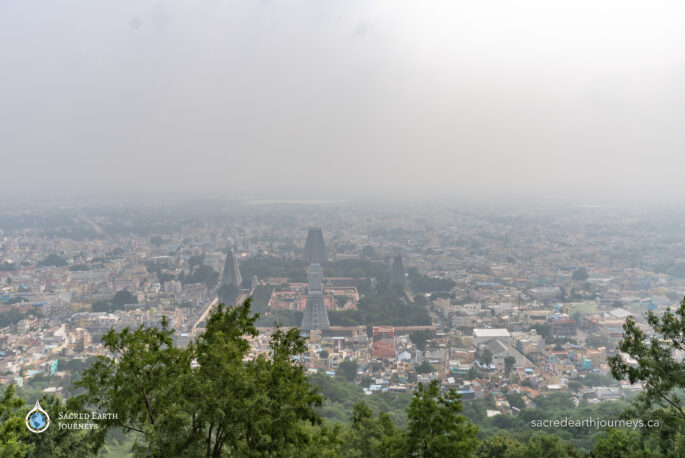
Ramana Maharshi, Self-Inquiry, and the Consciousness That Watches
There are sacred places we travel to in search of something.
And then there are places that seem to turn the search back upon us.
Rising above Tiruvannamalai in South India, Mount Arunachala has been revered for centuries as a manifestation of Shiva, not represented by an image or enclosed within a temple, but present as the mountain itself.
For the great twentieth-century sage Ramana Maharshi, Arunachala became something even more intimate.
It was not merely sacred ground.
It was Guru.
It was Self.
It was the still center around which his entire spiritual life unfolded.
And this may be one of the most radical teachings Arunachala offers the modern pilgrim:
What if consciousness does not need to travel outward to find the sacred? What if the deepest pilgrimage is the movement back toward the one who is doing the seeking?
The Mountain That Called Ramana
Ramana Maharshi arrived at Arunachala as a sixteen-year-old and remained in its presence for the rest of his life.
Long before he physically saw the mountain, its name had already carried an almost inexplicable power for him. After a profound inner confrontation with death awakened in him an awareness of something untouched by the death of the body, he left home and made his way to Tiruvannamalai.
The outer journey ended at Arunachala.
The inner journey had only begun.
Ramana would eventually become known for the practice of atma vichara, or self-inquiry, distilled into one deceptively simple question:
Who am I?
The question is not intended to produce an intellectual answer.
It is meant to interrupt the habitual movement of consciousness outward.
We spend most of our lives aware of something.
A thought.
A memory.
A desire.
A body.
A fear.
A landscape.
Even a spiritual experience.
Ramana’s inquiry asks us to turn attention in the opposite direction.
Who is aware of all of this?
In his Five Stanzas to Sri Arunachala, Ramana describes the one who turns inward to discover where the sense of “I” arises as ultimately dissolving into Arunachala, like a river entering the ocean.
Suddenly, the mountain becomes more than geography.
It becomes an image of consciousness itself.
Still.
Present.
Unmoved by everything passing across it.
Sri Ramanasramam: Five Stanzas to Sri Arunachala
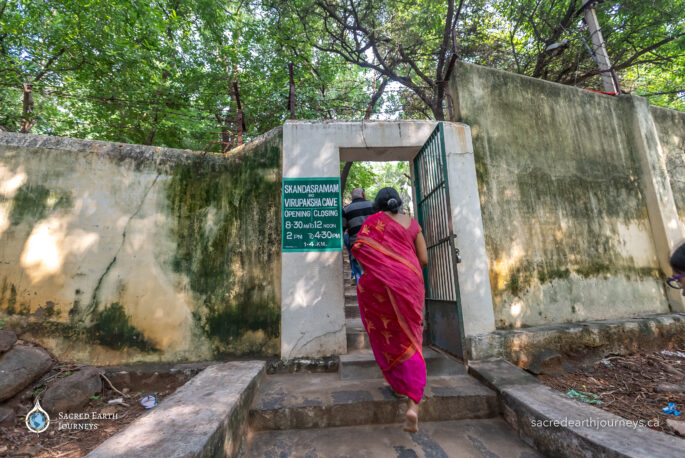
The entrance to Virupaksha Cave where Ramana Maharshi meditated for 20 years:
From Object to Awareness
This offers us a very different way to think about spiritual transformation.
We often imagine awakening as the acquisition of something we do not yet possess.
More wisdom.
More peace.
A higher state.
A mystical experience.
Ramana points in almost the opposite direction.
His teaching suggests that transformation begins when consciousness ceases identifying entirely with what appears within awareness and begins recognizing the awareness in which everything appears.
In another of his teachings, Ramana uses the image of a cinema screen. We become so absorbed in the picture that we forget the screen upon which the entire drama is appearing.
Thoughts move.
Emotions move.
Identities change.
The body changes.
The story changes.
Yet something remains present enough to witness every change.
Ramana called us back toward that presence.
Andrew Harvey has spent decades bringing this kind of mystical wisdom into dialogue with contemporary seekers. His anthology Teachings of the Hindu Mystics brings together the Upanishads, the Bhagavad Gita, Ramakrishna, Ramana Maharshi, and other voices from the Hindu mystical tradition.
Underlying the collection is an idea that also runs deeply through Andrew’s wider work: mysticism is not something merely to be understood. It must ultimately be experienced.
Andrew Harvey’s Teachings of the Hindu Mystics
For Andrew, South India is where much of this understanding became personal.
He has described the region as his “soul’s home” and a place where he was himself mystically formed.
And nowhere does he speak about that power more intensely than Arunachala.
A Mandala of Blessing
Andrew has called Arunachala the “most potent and mysterious” pilgrimage place in South India, describing the entire landscape as a “mandala of blessing.”
That description is worth lingering over.
A mandala is not simply a beautiful geometric image. Within spiritual traditions, it can represent an ordered sacred field centered upon an essential reality.
To describe an entire mountain as a mandala suggests that one does not merely look at Arunachala.
One enters its field.
The mountain becomes the center.
The pilgrim begins to move around it.
And slowly, the relationship between movement and stillness becomes the teaching.
This November, our journey with Andrew brings us into this practice directly. At Arunachaleswarar Temple, situated at the foot of the mountain, pilgrims enter one of Tamil Nadu’s great centers of Shiva devotion. Later, we walk in the presence of Mount Arunachala along its ancient circumambulatory path.
Andrew has described circling the mountain as an offering of the whole being to transformation.
The body moves.
The mountain does not.
Thought moves.
Awareness remains.
The pilgrim circles the center until the symbolism becomes almost impossible to miss.
Andrew Harvey on the Spiritual Power of South India
Why Walk in a Circle?
To the modern mind, progress usually means moving forward.
Pilgrimage often teaches something stranger.
Sometimes transformation requires circling.
Returning.
Encountering the same center from another angle.
The tradition of pradakshina, circumambulating a sacred presence, turns walking itself into contemplation. The destination is not somewhere ahead. The sacred remains continually beside the pilgrim, while the pilgrim moves around the center.
This creates a radically different relationship with time and movement.
We are not rushing toward an endpoint.
We are becoming increasingly conscious of the center.
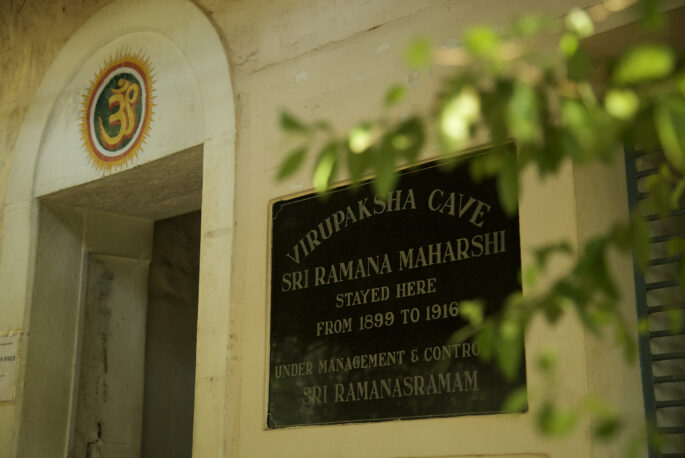
Our journey brings this teaching into lived experience through walking in the presence of Mount Arunachala, followed by an ascent to Virupaksha Cave, where Ramana Maharshi lived and meditated for many years.
There, the teaching becomes quieter still.
No monumental architecture is required.
A cave.
A mountain.
Silence.
Attention.
And the question:
Who is aware?
The Silence Beneath Thought
One of the most compelling aspects of Ramana Maharshi’s teaching is that silence was not an absence of instruction.
Silence itself was instruction.
This can be difficult for a culture accustomed to equating knowledge with information.
We assume understanding requires explanation.
Ramana’s path suggests there are truths that become less visible the more conceptual noise we place around them.
Consciousness is already present before the explanation.
Before the belief.
Before the story we tell about ourselves.
The practice is not to manufacture that awareness.
It is to recognize it.
This is also why Andrew Harvey’s understanding of pilgrimage matters.
In his conversation with Sacred Earth Journeys, Andrew described this journey through South India explicitly as a “pilgrimage into the self.”
Not an escape from the world.
Not spiritual tourism.
A movement inward that ultimately changes how we return to the world.
Andrew has spoken about practices that help distinguish the transient ego from what he describes as the essential, peaceful, radiant Self. And through his wider work on Sacred Activism, he asks us to carry inner realization beyond ourselves, allowing spiritual understanding to become compassionate action in the world.
The journey inward is therefore not meant to end in withdrawal.
The deeper we become rooted in awareness, the less entirely controlled we are by fear, reactivity, and the endless fluctuations of thought.
Stillness becomes a source of action.
The center becomes a source of movement.
When the Landscape Becomes the Teaching
Perhaps this is what makes Arunachala so unusual.
The philosophy is visible in the landscape itself.
The mountain stands still.
The pilgrim moves around it.
The cave invites silence.
The ashram preserves the presence and teachings of Ramana Maharshi.
The temple gives form to the ancient understanding of Arunachala as Shiva.
And through all of it runs a single invitation:
Turn inward.
Not because the outer world is meaningless.
But because we cannot truly meet the world until we understand something about the consciousness through which we are meeting it.
Ramana’s teaching asks us to question the identity we usually take for granted.
Andrew Harvey’s work asks what becomes possible when such mystical realization is embodied in the world.
And Arunachala brings these two movements together.
Into the Self.
And back into life.
The Pilgrimage Within the Pilgrimage
This November 5 to 19, 2026, Sacred Earth Journeys returns to South India for Shiva Dancing: Sacred South India with Andrew Harvey.
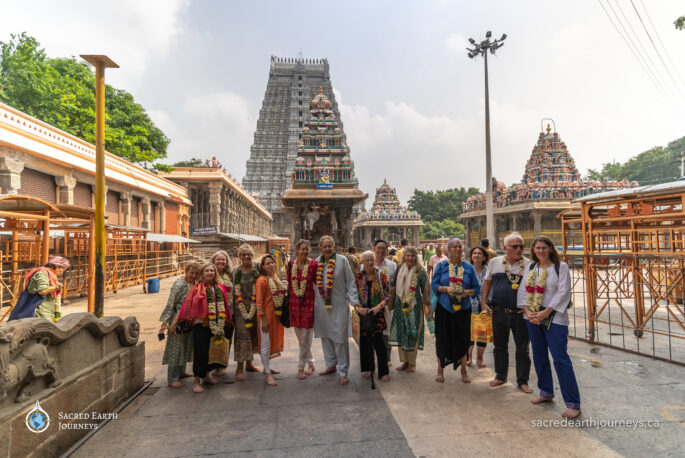
Near the culmination of our pilgrimage, we enter Tiruvannamalai to spend time at Sri Ramana Maharshi Ashram, Arunachaleswarar Temple, Mount Arunachala, and Virupaksha Cave, moving through the very landscape in which these teachings have been contemplated and lived for generations.
But perhaps the true invitation of Arunachala is not simply to encounter a sacred mountain.
It is to discover what becomes visible when we grow quiet enough to encounter ourselves.
Pilgrimage creates a rare space in our lives. Removed from familiar rhythms and identities, walking ancient paths, entering temples, sitting in silence, and returning again and again to the sacred, something within us can begin to soften. The noise becomes quieter. What once felt essential falls away. And beneath it, we may begin to recognize a deeper presence that was never absent, only obscured.
This is the transformation at the heart of pilgrimage.
We do not necessarily return with more. We may return having released enough to see differently.
To walk Arunachala with Andrew Harvey is therefore not simply to follow in the footsteps of Ramana Maharshi. It is to enter the question he devoted his life to:
Who am I beneath everything I have learned to call myself?
And perhaps we travel to sacred places because there are some questions that cannot be answered from a distance.
They must be walked.
They must be lived.
And sometimes, they must be carried to the foot of a mountain and offered into silence.
If you feel called to experience this pilgrimage into the sacred heart of South India, now is the time to answer that call. Registrations for Shiva Dancing: Sacred South India with Andrew Harvey are needed by mid-September, or sooner, as we prepare for our November departure.
Shiva Dancing: Sacred South India with Andrew Harvey
November 5–19, 2026
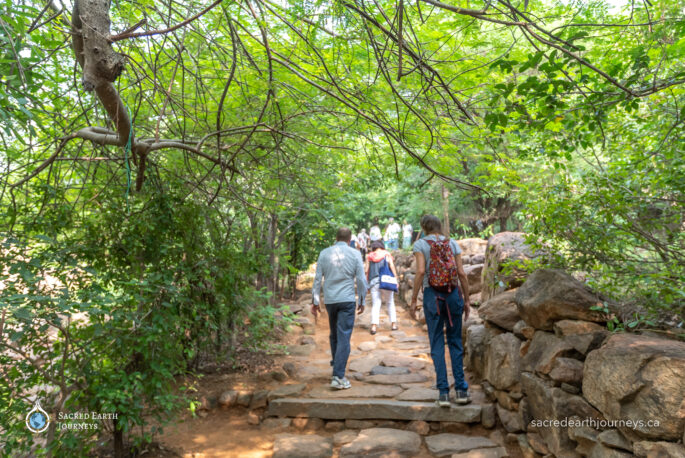
Pilgrims on our journey hiking up to Arunachala mountain to visit Ramana’s Cave.