Turkey is a land where civilizations did not simply rise and fall, they revealed themselves. It is a place where continents meet, where sacred architecture reshaped skylines, and where mystics turned longing into a path of transformation. To journey through Turkey consciously is to move through layers of human devotion. From Neolithic settlements to Byzantine cathedrals, from Ottoman mosques to the ecstatic poetry of Rumi.
Istanbul: Where Empires and Devotion Converge
Our journey here begins in Istanbul, the ancient city once known as Byzantium and later Constantinople. For over fifteen centuries, it has served as a spiritual and political axis point between East and West.
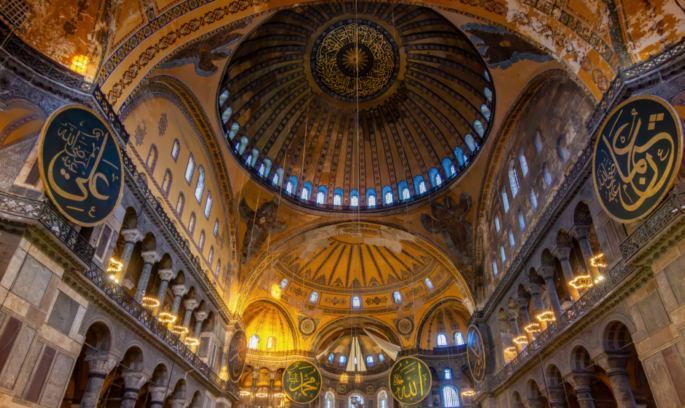
Inside Hagia Sophia, built in 537 CE, the massive dome appears suspended between heaven and earth. Originally a Byzantine cathedral, later an Ottoman mosque, and now functioning again as a mosque, Hagia Sophia embodies the layered spiritual inheritance of this land. Christian mosaics shimmer alongside Islamic calligraphy, revealing how sacred space can transcend division.
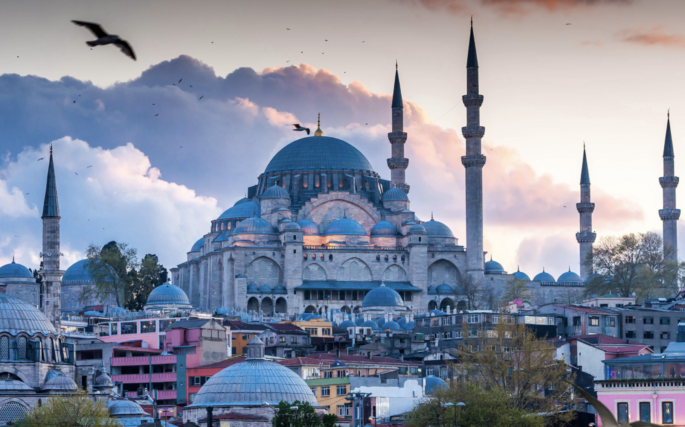
Nearby, the Blue Mosque stands as a masterpiece of Ottoman sacred geometry. Its cascading domes and symmetry reflect the Islamic understanding of divine unity expressed through architectural harmony. In contrast, the subterranean Basilica Cistern reminds us that even beneath the city’s visible grandeur lies hidden infrastructure columns rising from water, like a secret temple below ground.
At the historic Hippodrome, once the ceremonial heart of Byzantine Constantinople, and within the imperial courtyards of Topkapi Palace, we witness how governance, spirituality, and cosmology were once inseparable. Even the vibrant Spice Bazaar reflects Istanbul’s historic role as a crossroads of civilizations, trade routes, and spiritual exchange.
Istanbul sets the tone: this is a land shaped by devotion, empire, and sacred imagination!
Cappadocia and Göreme: The Earth as Sanctuary
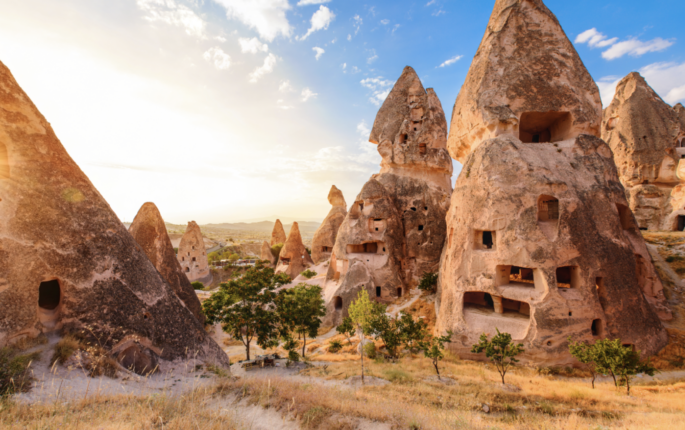
From the urban grandeur of Istanbul are the striking landscape of Cappadocia and Göreme. Here, volcanic stone has been carved into cave churches, monasteries, and dwellings since the early centuries of Christianity.
The region became a refuge for early Christian mystics who sought contemplative lives carved directly into the earth. Frescoes still line the interiors of rock-cut chapels, depicting biblical scenes preserved in mineral pigment. These spaces feel intimate and inward, emphasizing silence and prayer rather than monumental scale.
Cappadocia reflects a central mystical principle found in many traditions: the sacred is not always built upward; sometimes it is carved inward. The landscape invites reflection and stillness, qualities that are essential to the contemplative path Andrew Harvey often speaks about as preparation for deeper mystical awakening.
Çatalhöyük: Remembering the Earliest Sacred Communities
One of the most profound sites on this journey is Çatalhöyük, one of the oldest known Neolithic settlements in the world, dating back over 9,000 years.
Unlike later civilizations that separated temple from home, Çatalhöyük integrated spiritual symbolism directly into daily life. Shrines existed within domestic spaces. Symbolic imagery, including feminine forms, adorned walls. Ritual and community were intertwined.
For those interested in the evolution of sacred consciousness, Çatalhöyük represents something extraordinary: evidence that humanity’s spiritual impulse is ancient and communal. Long before organized religion, human beings were marking space as sacred and orienting their lives around unseen forces.
Standing at Çatalhöyük invites reflection on how spiritual awareness has evolved and how it continues to call us back to integration rather than division.
Konya: Rumi, Shams, and the Path of Divine Love
The spiritual heart of Konya lays the home of the 13th-century Sufi mystic Jalāl ad-Dīn Rumi.
At the Mevlana Museum, where Rumi’s tomb rests beneath its iconic green dome, pilgrims encounter the living legacy of Sufism. Rumi’s poetry speaks of longing, annihilation of ego, and ecstatic union with the Divine that continues to resonate across cultures and religions.
Then theres Şems-i Tebrizi Mosque and Tomb. Honoring the wandering mystic Shams of Tabriz, whose encounter with Rumi transformed him from respected scholar into burning lover of God. Without Shams, Rumi’s mystical flowering would never have occurred. Their relationship exemplifies the Sufi understanding that spiritual awakening often comes through radical love and sacred friendship.
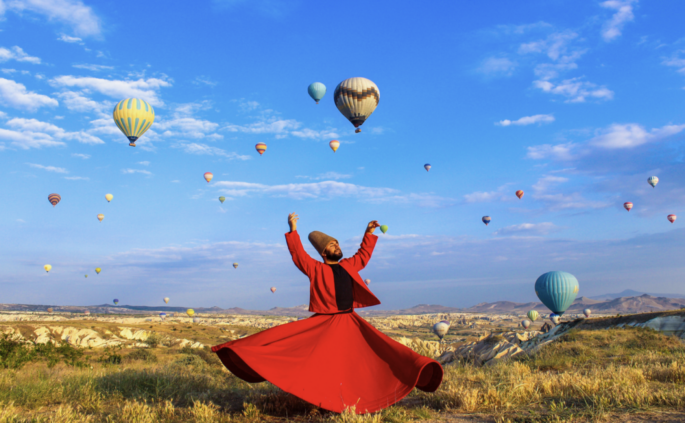
At the historic Karatay Medrese, once a Seljuk theological school, we gain insight into the intellectual and spiritual environment that shaped 13th-century Islamic mysticism. Konya was not only a place of devotion; it was a center of learning, theology, and philosophical exploration. Konya is the sacred commemoration of Rumi’s passing, known as the Wedding Night (Şeb-i Arus). In Sufi tradition, death is not mourned as loss but celebrated as union with the Beloved. The whirling dervishes turn in ceremony, embodying the cosmic dance of surrender and remembrance.
Andrew Harvey has devoted decades to studying Rumi and Sufi mysticism, guided by revered teachers and rooted in a lifelong exploration of divine love as a force for transformation. Under his guidance, the Wedding Night becomes not merely a cultural event, but a contemplative initiation into what it means to live a love-centered life.
Ephesus: The Divine Feminine and Early Christian Devotion
The Aegean coast and the ancient city of Ephesus, one of the most significant archaeological sites in the Mediterranean world. Here, we encounter the remains of the Temple of Artemis, once considered one of the Seven Wonders of the Ancient World. Dedicated to a powerful goddess figure, the temple reflects the region’s deep history of Divine Feminine veneration.
Nearby stands the Basilica of St. John, traditionally believed to mark the burial site of John the Apostle, linking Ephesus to early Christian history. A short distance away is the revered House of the Virgin Mary, a pilgrimage site honored by both Christians and Muslims.
In Ephesus, these threads converge: goddess devotion, Christian mysticism, and sacred motherhood. Andrew Harvey often speaks of the sacred marriage, the integration of masculine and feminine, action and contemplation, justice and compassion. Ephesus becomes a landscape through which this union can be contemplated and experienced.
The Larger Sacred Landscape of Turkey
While much discussion exists in esoteric circles about ley lines and energetic grids connecting ancient civilizations, what is historically undeniable is that Anatolia has long served as a crossroads of spiritual transmission. Trade routes, philosophical ideas, theological developments, and mystical movements flowed through this region for millennia.
From Neolithic Çatalhöyük to Byzantine Istanbul, from Cappadocian cave sanctuaries to Sufi Konya and the goddess traditions of Ephesus, Turkey reveals a continuity of sacred inquiry!
It is a land where humanity has consistently asked its deepest questions.
An Invitation Into the Story
From December 8–20, 2026, join our sacred pilgrimage as we will walk this divine path together with Andrew Harvey! Moving through Istanbul, Cappadocia, Çatalhöyük, Konya during Rumi’s Wedding Night, and onward to Ephesus.
This is not simply a cultural journey. It is an immersion into Sufi mysticism, early Christian devotion, ancient sacred communities, and the enduring human longing for union with the Divine.
If you feel called to explore the sacred essence of Turkey and the transformative wisdom of Rumi’s path of love, we would be honored to welcome you!
Some journeys inform you.
Others transform you.