
To be explored on our upcoming journey through Japan in 2026.
Japan is often described as a land of contrasts, ancient and modern, serene and vibrant, delicate and fierce. Yet beneath these dualities lies a deeper truth: Japan is a place where the sacred has never retreated. It lives in the mountains. It hums in the temples. It whispers through cedar forests, and echoes through rituals that have been continuously practiced for more than a thousand years.
For seekers, pilgrims, and lovers of mystery, Japan is not simply a country.
It is a living mandala. A world where myth breathes and spirit gathers.
Kyoto: Where Silence Teaches
If the soul had a library, Kyoto would be one of its oldest books.
For over a millennium, Kyoto has been the spiritual heart of Japan. Its temples are not just buildings, they are ritual technologies, designed to refine the mind and open the heart. Places like Ryōan-ji, famous for its enigmatic rock garden, were crafted not as landscapes but as koans. They pose questions that cannot be answered with the analytical mind:
What is stillness?
What is emptiness?
What is the shape of your own awareness?
In Zen Buddhism, the emphasis is on direct experience, sudden insight, deep presence, intimate contact with reality. This is why the temples of Kyoto feel alive. They hold a long lineage of seekers who sat, breathed, questioned, awakened. To walk their grounds is to feel the residue of thousands of moments of illumination.
Mount Kōya: The Esoteric Heartbeat
Mount Kōya, or Kōyasan, is not simply a sacred site.
It’s Japan’s spiritual north star.
Founded by the monk Kūkai (also known as Kōbō Daishi) in the 9th century, Kōyasan became the cradle of Shingon Buddhism, a tantric tradition steeped in mantra, mudra, mandala, and esoteric ritual. Here, Buddhism took on a mystical form, not as philosophy but as a living, embodied path.
The mountain itself is considered a mandala of the universe, with its monasteries positioned as cosmic nodes. Pilgrims come here for initiation, purification, and deep retreat. The famous Okunoin cemetery where Kūkai is said to remain in eternal meditation. It reminds visitors that enlightenment is not an abstract idea but a continuum, woven into the lineage of all who seek.
To enter Kōyasan is to enter a field of ancient practice.
You can feel it in the air – thick, quiet, charged.
Kumano: Where Shinto, Buddhism, and Nature Merge
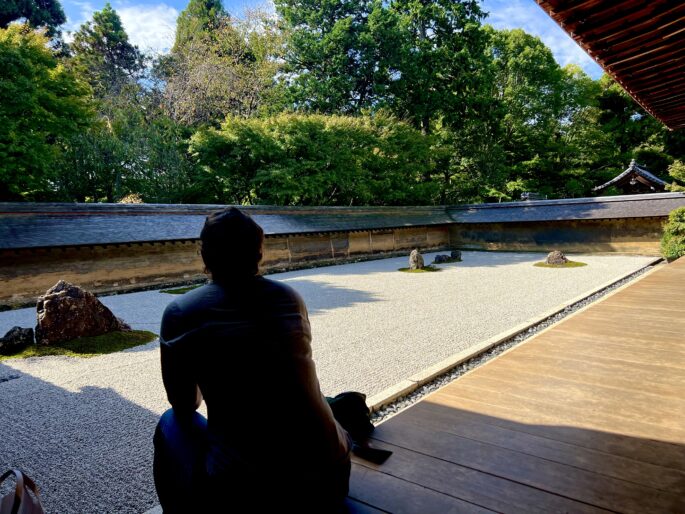
Observing the pure stillness in a Zen rock garden in Japan.
Long before Buddhist monks shaped temples or Zen gardeners raked gravel into galaxies, Japan’s indigenous spirituality, Shinto – honored mountains, waterfalls, trees, wind, and stone as living beings. In the Kumano region, this animistic spirit blends seamlessly with Buddhism to form Shugendō, Japan’s mountain shamanic tradition.
For more than a thousand years, pilgrims have walked the steep cedar-lined paths of the Kumano Kodo, undertaking rituals of endurance and purification. This is not metaphor, this is literal practice:
breath, step, sweat, surrender.
At Nachi Falls, the tallest waterfall in Japan, pilgrims believe the divine descends in the rushing water. At Kumano Hongū Taisha, the three-legged crow Yatagarasu serves as a guide of ancient myth, symbolizing spiritual direction and rebirth.
Kumano is less a place you visit and more a presence you meet while embarking on a sacred journey through Japan.
Why These Traditions Still Matter
In a world increasingly dominated by speed, fragmentation, and digital overwhelm, the Japanese spiritual traditions offer an antidote:
• Zen teaches us to return to stillness, to see the truth beneath noise.
• Shingon Tantra reminds us that everything is sacred – every sound, gesture, breath
• Shugendō shows that our healing is inseparable from the land we walk on.
• Shinto invites us to bow to the spirit in all things, seen and unseen.
These aren’t relics of an old world. They’re the very medicine the modern world is yearning more of.
A Pilgrimage into Living Mysticism
In October 2026, Dr. Miles Neale will guide a small group of seekers through these sacred regions, not as tourists, but as pilgrims entering a living spiritual lineage. Together we will meditate in Zen temples, stay in monastic lodgings on Kōyasan, walk the ancient Kumano trails, and learn directly from spiritual teachers and practitioners who carry these traditions forward.
This journey is an initiation into nature, into presence, into myth, into yourself.
If your heart has ever longed for a deeper way of seeing, or if the old stories within you are beginning to stir, we invite you to walk this path with us.
Space is still available, and the call of Japan is strong.
Perhaps it’s calling you!
Please find more details about our upcoming 2026 journey to Japan here
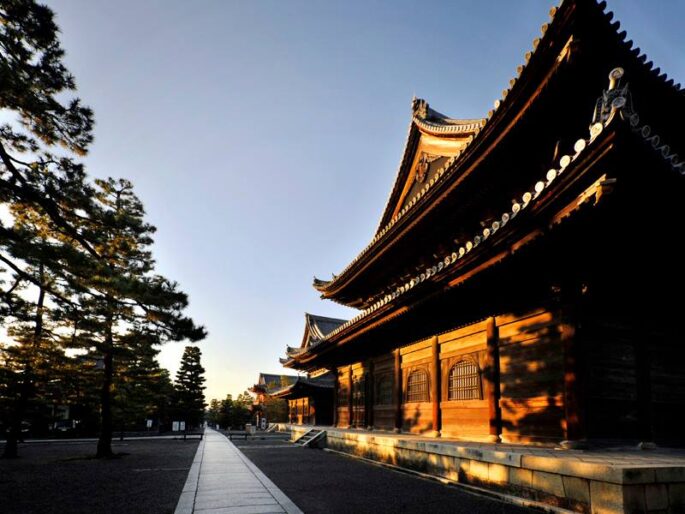
Ancient temple glowing in the sunset light of Japan. All photo rights reserved.