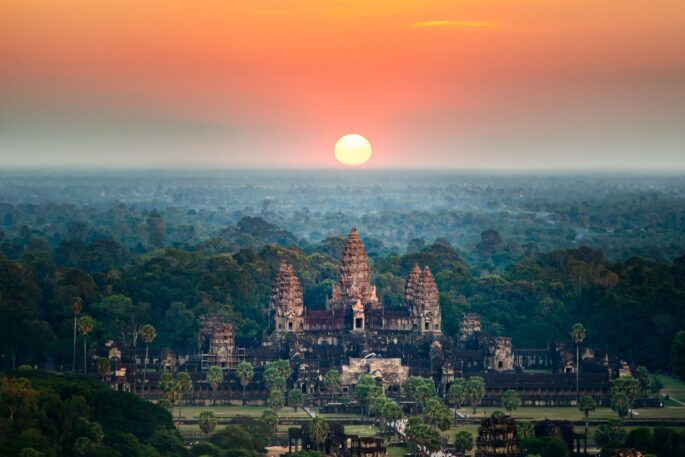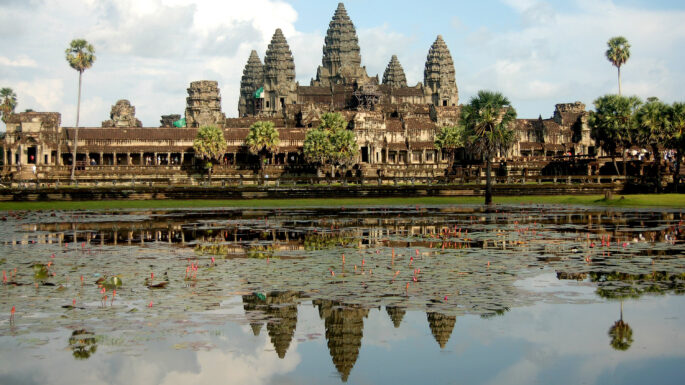
There are sacred sites that inspire awe, and then there are sacred sites that seem to alter consciousness itself—Angkor Wat belongs to the latter.
For centuries, pilgrims, mystics, scholars, and seekers have stood before its immense stone towers with the same impossible question echoing through them: How was this created? But perhaps the deeper question is not merely how it was built…but why.
Because Angkor Wat was never intended to simply be admired. It was designed to initiate.
Hidden within its architecture is an astonishing fusion of sacred geometry, cosmology, astronomy, mythic symbolism, and energetic intelligence, so sophisticated that even modern researchers continue uncovering new layers of meaning encoded within the complex. To walk through Angkor is to move through what many believe is one of the most complete spiritual maps ever constructed in stone!
For Andrew Harvey, Cambodia represents one of the great surviving spiritual hearts of the Earth: A place where sacred beauty still radiates through unimaginable suffering, where compassion survived devastation, and where the human soul remembers its capacity for resurrection. Cambodia’s temples are not relics of a dead civilization. They remain profoundly alive.
Angkor Wat as a Living Mandala
Ancient Khmer architects did not separate spirituality from mathematics, astronomy, architecture, or the movement of the cosmos. For them, the temple was the cosmos.
Angkor Wat was designed as a terrestrial mirror of the universe itself. Scholars have long confirmed that the entire complex was constructed according to sacred cosmological principles rooted in Hindu and later Buddhist traditions.
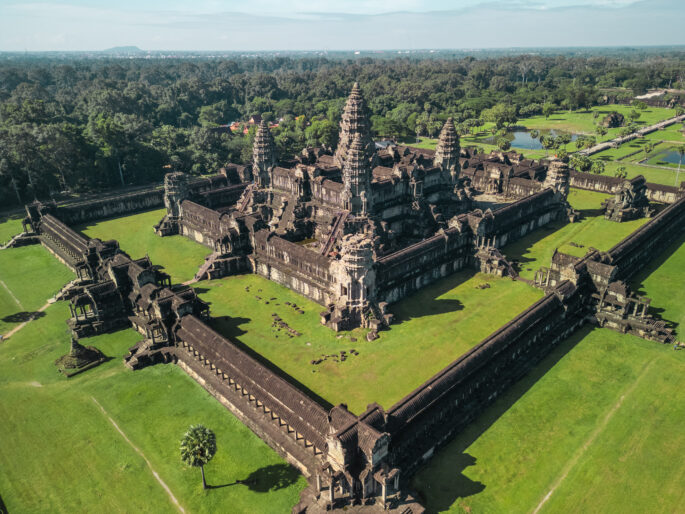
At its center stand five soaring towers representing Mount Meru, the mythic axis mundi, the spiritual center of all worlds in Hindu cosmology. Surrounding galleries symbolize mountain ranges; vast moats represent the cosmic oceans encircling existence itself. Every enclosure guides the pilgrim inward through progressively more sacred dimensions of space and consciousness.
But Angkor Wat’s mysteries go even deeper than symbolism.
Researchers have identified extraordinary numerical correspondences hidden within the temple’s dimensions, measurements that appear to encode vast cosmological cycles, including the yugas, or sacred ages of time described in ancient Indian texts. The geometry of the temple follows highly advanced proportional systems rooted in ancient Hindu architectural treatises and sacred grid systems.
Even more astonishing are its astronomical alignments.
At specific times of year, the rising sun aligns with the temple’s central towers with breathtaking precision. Researchers have documented alignments connected to equinoxes, solstices, solar cycles, and celestial observations embedded directly into the structure itself.
This is why so many pilgrims describe Angkor not merely as architecture, but as an energetic experience.
The temple appears intentionally designed to create resonance between the body, the Earth, and the cosmos. Movement through its corridors becomes ritualized; proportion affects perception; symmetry induces stillness. Sacred geometry here is not decorative, it is functional.
Ancient civilizations understood something modern culture has largely forgotten: geometry has the power to shape consciousness.
The Stones That Speak
One of the most haunting experiences within Angkor is the sensation that the stones themselves are alive.
Miles of intricate bas-reliefs line the galleries, celestial dancers, mythic battles, serpent beings, gods, goddesses, and cosmic events carved with impossible precision. Yet these carvings were never intended as mere artistic decoration.
In ancient traditions across Egypt, India, and Cambodia, sacred images were believed to hold living energetic transmissions. Through ritual consecration, mantra, geometry, and devotion, temples became charged vessels of spiritual frequency.
This is one of the reasons Angkor Wat is often compared to the great temple complexes of Giza Necropolis in Egypt.
Many researchers and mystics including writers like Graham Hancock have explored striking energetic, astronomical, and symbolic correspondences such as ley lines between ancient sacred sites across the world, particularly Egypt, Cambodia, Peru, and Mesoamerica. These theories propose that ancient civilizations have intentionally constructed temples along planetary energy alignments or geomantic pathways connecting key spiritual centers of the Earth.
What remains undeniable is that both Egypt and Angkor reveal extraordinary parallels: celestial alignments, sacred mathematics, cardinal orientations, mythic cosmology encoded in architecture, and immense stone construction whose sophistication continues to astonish researchers today.
For Andrew Harvey, these sacred sites matter not because they prove ancient technological superiority, but because they remind humanity of something sacred civilizations once understood: that the universe itself is alive, intelligent, interconnected, and participatory.
Ta Prohm and the Sacred Intelligence of Nature
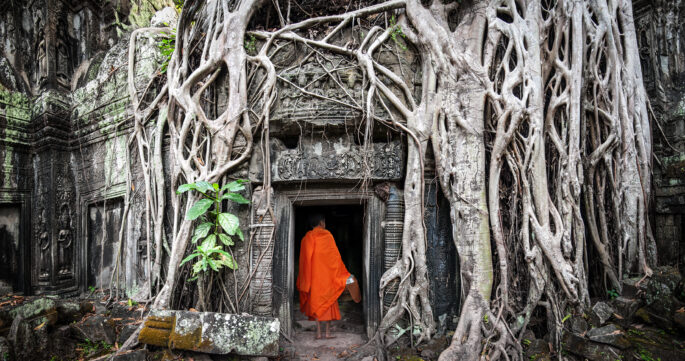
Among the most unforgettable temples in Cambodia is Ta Prohm, where enormous silk-cotton tree roots pour over ancient stone walls like rivers of time.
Unlike many Angkorian temples restored into pristine form, Ta Prohm was intentionally left partially overtaken by the jungle. The result is breathtaking, a visible union between civilization and nature, spirit and Earth.
Here, Cambodia reveals one of its deepest teachings: impermanence is not destruction. It is transformation.
Nature does not erase the sacred. It absorbs it, carries it, and rebirths it into new form.
This truth feels especially poignant in Cambodia, a nation that endured profound collective trauma during the Khmer Rouge era. And yet somehow, through all its suffering, Cambodia remains one of the gentlest, most spiritually luminous places on Earth.
Andrew Harvey often speaks of “holy heartbreak” as the mysterious alchemy through which suffering can become compassion, and devastation can become awakening. Cambodia embodies this teaching powerfully. Its beauty is not naïve beauty. It is resurrected beauty.
Bayon and the Faces of Infinite Compassion
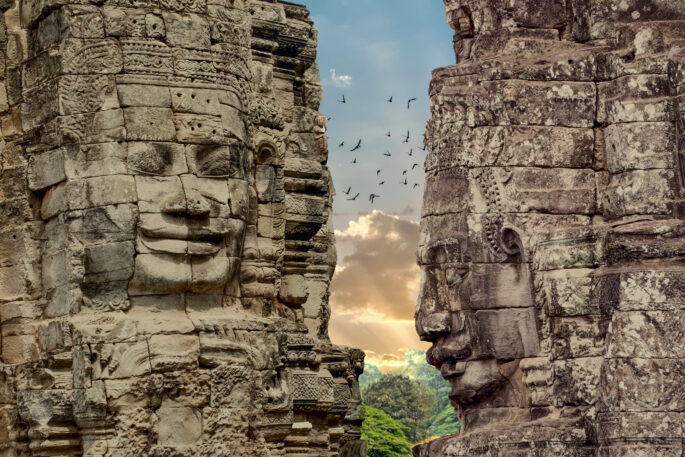
At the center of Angkor Thom stands Bayon Temple, crowned by over two hundred serene stone faces gazing silently in every direction.
No matter where you stand, the faces seem to meet your eyes.
Many scholars believe these faces represent Avalokiteshvara, the bodhisattva of infinite compassion. Others see them as an enlightened fusion between deity and king. But beyond interpretation, Bayon radiates something unmistakable: presence.
Stillness. Mercy. Awareness.
This compassionate frequency permeates Cambodia itself.
It lives in saffron-robed monks moving quietly through temple courtyards, in incense smoke drifting through village shrines, in the humility and softness of the Cambodian people, and in the strange tenderness pilgrims often feel while walking these ancient grounds.
Cambodia does not overwhelm the spirit. It opens it.
Cambodia and the Path of Living Resurrection
Perhaps this is why pilgrimage to Cambodia feels so profoundly transformational.
The temples remind us that sacred wisdom can survive centuries of collapse. That beauty can rise again after devastation. That consciousness itself may be woven into stone, geometry, and the living Earth.
This is the essence of what Andrew Harvey calls sacred resurrection, not an escape from suffering but the rebirth of the soul through love, compassion, devotion, and awakened remembrance.
Cambodia teaches this not philosophically, but experientially.
Its temples are not frozen ruins of the past. They are living initiatory fields inviting humanity to remember who we are beneath distraction, fear, and fragmentation.
And perhaps this is why so many who visit Angkor leave feeling altered in ways they cannot fully explain.
Something ancient awakens there.
Something timeless.
Something waiting.
A Sacred Pilgrimage into Cambodia’s Living Wisdom
In 2027, Sacred Earth Journeys will embark on Sacred Cambodia: The Path of Living Resurrection with Andrew Harvey, Apr 17-30, 2027—a profound pilgrimage into the spiritual heart of Cambodia and the sacred mysteries of Angkor.
This journey is not simply about seeing temples. It is about entering living fields of wisdom, sacred geometry, compassion, and transformation alongside one of the world’s great spiritual teachers.
For those who feel called to explore Cambodia’s extraordinary beauty, mystical depth, and ancient intelligence firsthand, we invite you to discover more through Sacred Earth Journeys ✨