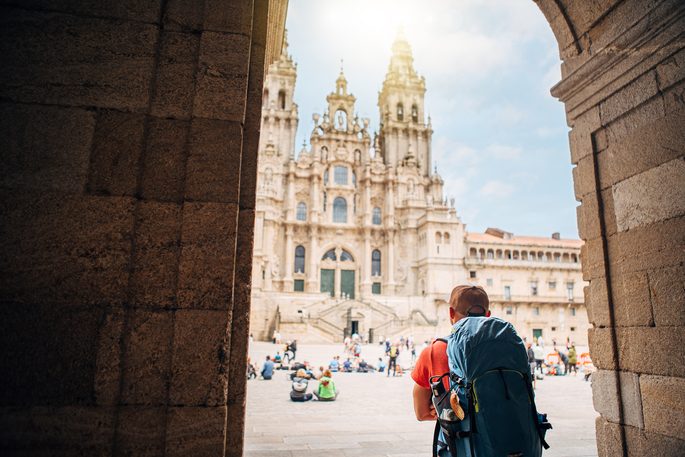
For thousands of years, humanity has followed an extraordinary calling: to journey beyond the familiar in search of the sacred. From the mysteries of ancient civilizations to the living pilgrimage paths of today, discover why this timeless practice continues to awaken, transform, and illuminate the human spirit.
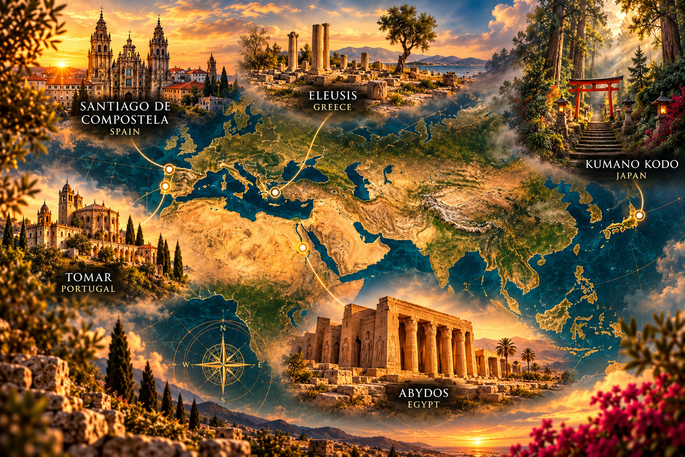
The Ancient Calling of the Pilgrim
Imagine standing upon a path worn into the earth by the footsteps of countless generations before you.
You do not know their names, the lives they lived, or the prayers they carried. Yet something extraordinary connects you to them. Across centuries, you have arrived at this same place, drawn by a longing to encounter something greater than the world you know.
This is the ancient calling of pilgrimage.
For thousands of years, people have left the familiarity of their homes and ventured across mountains, deserts, forests, and seas toward places they believed could bring them closer to the Divine.
Some carried prayers for healing. Others sought wisdom, forgiveness, initiation, or a deeper understanding of life’s mysteries. Many traveled through considerable hardship, guided by faith in something they could neither see nor fully explain.
But what makes pilgrimage so extraordinary is not simply the distance traveled, the destination reached, or even the sacred rituals performed along the way.
It is the possibility that by moving through the world with intention, we begin to move differently within ourselves.
Following the Footsteps of Our Ancestors
The origins of pilgrimage reach so deeply into human history that no single civilization can claim its beginning.
Long before the great pilgrimage routes of medieval Europe, ancient cultures were developing profound spiritual relationships with particular landscapes. Mountains became places of revelation, rivers were revered for their powers of purification, and temples were understood as meeting places between humanity and the Divine.
These sacred destinations drew generations of seekers, giving rise to remarkable traditions of ritual, initiation, and spiritual discovery.
In ancient Egypt, pilgrims traveled to Abydos, a sacred city associated with Osiris and the mysteries of death and resurrection. For worshippers gathering to honor the god’s story, the journey offered an opportunity to participate in a religious vision of existence in which death and renewal were intimately connected.
Evidence of these traditions survives in ancient monuments, including the nearly 4,000-year-old Stela of the Steward Mentuwoser, which records the importance of continued participation in the festivals of Osiris.
Explore this remarkable piece of Egyptian history at the Metropolitan Museum of Art.
Across the Mediterranean, ancient Greek initiates walked the Sacred Way from Athens to Eleusis, where they participated in the mysterious ceremonies honoring Demeter and Persephone.
Known as the Eleusinian Mysteries, these sacred rites explored the cycles of life, death, and renewal. Their innermost teachings were kept secret, yet the ceremonies endured for centuries, becoming among the most revered religious traditions of the ancient Greek world.
Imagine the anticipation of those who traveled this road, preparing to encounter mysteries that could not simply be learned through words, but had to be experienced.
Learn about the ancient Eleusinian Mysteries and the Sacred Way through the Acropolis Museum.
In India, pilgrimage developed around sacred rivers, mountains, temples, and cities where devotees sought blessings, purification, and spiritual liberation.
The Sanskrit word tirtha, often translated as a crossing place, carries a beautiful spiritual significance. Within Hindu traditions, it can describe a sacred threshold where passage between ordinary experience and divine reality becomes possible.
Along the Ganges in Varanasi, pilgrims continue to gather in prayer, honoring a sacred relationship with the river that has endured across generations.
Japan: The Sacred Mountains and the Path of Rebirth
Deep within Japan’s Kii Peninsula lies one of the world’s most extraordinary surviving pilgrimage traditions: the Kumano Kodo, an ancient network of paths winding through cedar forests, mist-covered mountains, sacred rivers, and waterfalls.
For more than a thousand years, pilgrims have journeyed into these mountains to reach the Three Grand Shrines of Kumano, known collectively as the Kumano Sanzan.
But what makes these pathways so remarkable is the spiritual understanding of the landscape itself.
Long before the routes became established pilgrimage trails, the mountains of Kumano were revered as dwelling places of the kami, sacred presences recognized within Japan’s indigenous religious traditions. As Buddhism spread through Japan, these beliefs gradually intertwined with Buddhist teachings, giving rise to a unique sacred geography in which mountains, forests, shrines, and waterfalls carried profound religious meaning.
During the medieval period, Kumano also became associated with the Buddhist Pure Land and the possibility of spiritual rebirth. Pilgrims, including members of Japan’s imperial court, undertook arduous journeys through these mountains, practicing prayer, purification, and acts of devotion along the way.
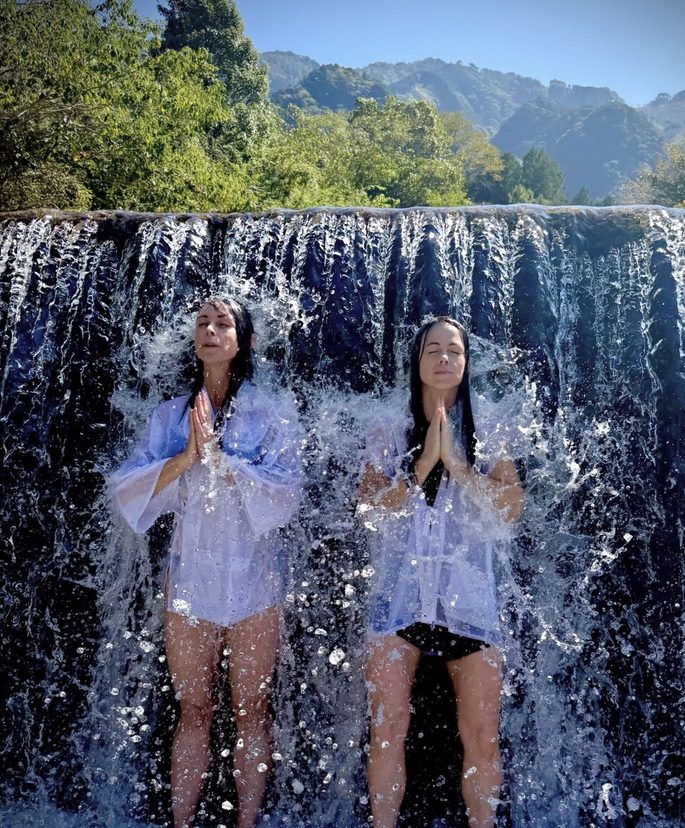
Within the mountain tradition of Shugendō, the wilderness itself became a place of spiritual training. Waterfalls, steep ascents, and physical endurance were incorporated into practices intended to cultivate discipline, purification, and a transformed relationship with the sacred.
The journey was never simply a passage between holy places. Walking the mountains was itself an essential part of the spiritual practice.
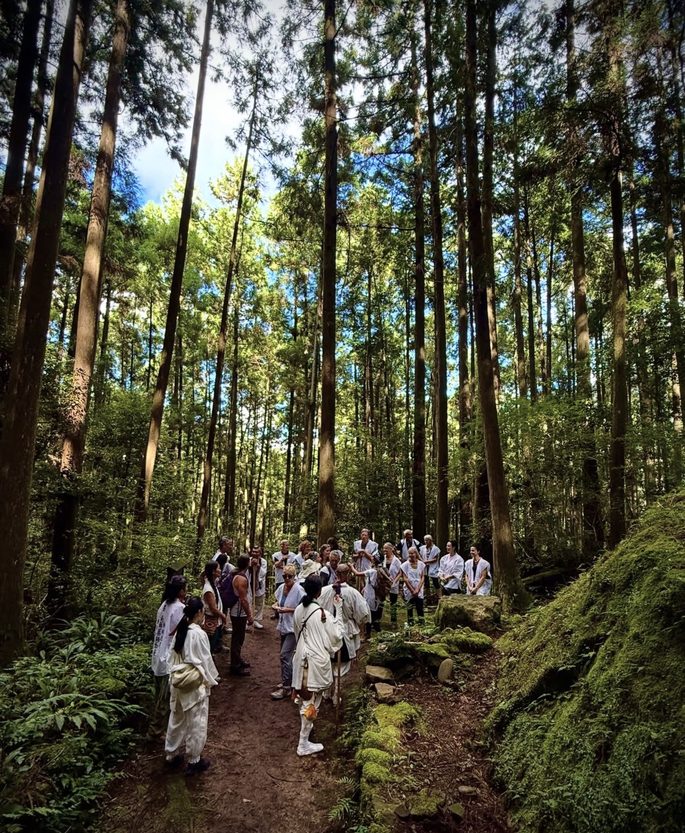
In his research on Japan’s sacred geography, Martin Gray explores how pilgrimage through the mountains came to be understood as a profound exercise in spiritual awakening, particularly through the relationship between Shingon Buddhism, sacred landscapes, and the traditions of Shugendō.
And remarkably, these pathways are not relics of a forgotten world. They remain living pilgrimage routes, where ancient shrines continue to welcome seekers and spiritual practices are still carried forward.
In October 2027, Sacred Earth Journeys invites pilgrims to experience this extraordinary tradition firsthand with Buddhist psychotherapist and spiritual teacher Dr. Miles Neale.
On Walk of Contemplation: Pilgrimage Through Mystical Japan, participants will journey through Kyoto, Mount Kōya, and the Kumano Kodo, exploring Zen Buddhism, Shingon Tantra, and Shugendō mountain traditions.
The pilgrimage includes contemplative walks through the ancient forests, visits to the Three Grand Shrines of Kumano, and participation in traditional purification practices, including a waterfall ritual.
Miles brings his distinctive integration of Buddhist philosophy and depth psychology to these sacred landscapes, inviting participants to explore the inner journey unfolding alongside the physical path.
As he expresses in the journey’s description:
“It’s not the destination but the journey that transforms us.”
Here, the wisdom of the ancient pilgrim becomes something we can experience ourselves, through mindful walking, ritual, contemplation, and direct encounter with Japan’s living spiritual traditions.
Explore the 2027 Walk of Contemplation pilgrimage in Japan (October 11–23).
Explore the sacred pilgrimage routes of the Kii Mountains through UNESCO.
The World’s Living Pilgrimage Traditions
From the sacred processions of ancient Egypt and Greece to the river pilgrimages of India and the mountain paths of Japan, these traditions reveal something remarkable.
Across vastly different cultures, people developed their own sacred geographies: landscapes understood through mythology, spiritual teachings, ancestral memory, and religious experience.
This extraordinary relationship between humanity and sacred geography is central to the work of Martin Gray, photographer, cultural anthropologist, and creator of SacredSites.com’s World Pilgrimage Guide.
Having spent decades researching and photographing sacred sites around the world, Gray explores the spiritual significance of these landscapes and the traditions that formed around them.
In his essay The Power of Place, he examines why particular mountains, temples, sanctuaries, and natural formations have inspired such enduring devotion.
Read Martin Gray’s The Power of Place.
While many ancient pilgrimage traditions remain alive today, few have become as widely recognized as the legendary road to Santiago de Compostela.
The Medieval Pilgrim and the Road to Santiago
By the Middle Ages, pilgrimage had become an essential expression of Christian devotion across Europe.
Among its most celebrated destinations was Santiago de Compostela, where a tomb believed to contain the remains of St. James the Apostle was reportedly discovered in the ninth century.
Over the centuries, a vast network of pilgrimage routes emerged, connecting distant cities, monasteries, churches, and sacred landmarks.
Pilgrims traveled for weeks or months, often facing difficult terrain, uncertain weather, and the dangers of unfamiliar roads. Along these pathways, communities established shelters, hospitals, bridges, and monasteries to support those making the journey.
The Camino became much more than a religious route. It grew into a remarkable network of cultural exchange, hospitality, and spiritual community, whose historical importance is recognized today by UNESCO.
The Knights Templar and the Mysteries of the Sacred Path
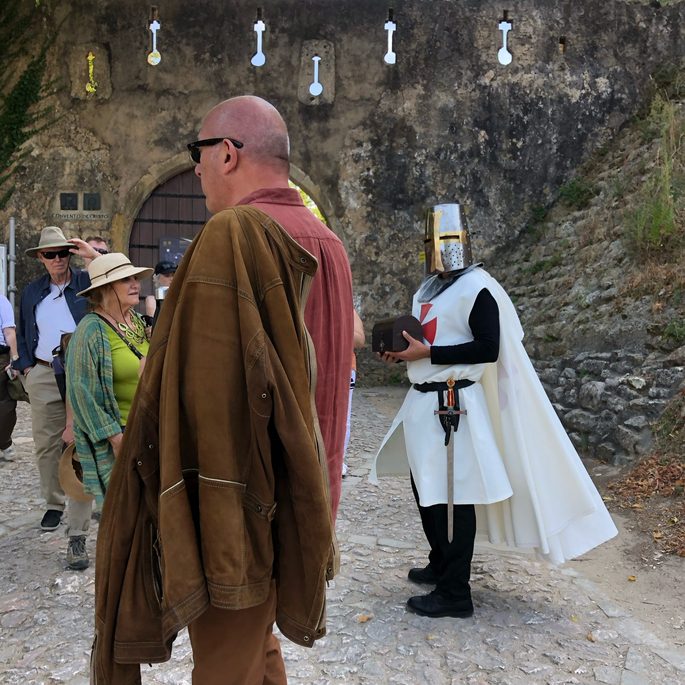
The history of medieval pilgrimage also intersects with one of Europe’s most enigmatic religious orders: the Knights Templar.
Established in the early twelfth century, the Templars were traditionally associated with protecting Christian pilgrims traveling to sacred destinations in the Holy Land.
Their extraordinary history continues to inspire research into medieval spirituality, sacred architecture, and the symbolism of religious initiation.
Among those exploring these mysteries is Sacred Earth Journeys leader Freddy Silva, whose book First Templar Nation presents an alternative interpretation of the Order’s origins and its connections to Portugal.
Silva investigates the relationship between Templar architecture, ancient spiritual traditions, and what he interprets as the symbolism of resurrection.
Describing the ceremonial founding of a Templar church in Portugal, he writes:
“The timing of the ceremony embodied the ancient Egyptian practice of performing the rite of resurrection at dawn.”
While Freddy Silva‘s interpretations extend beyond conventional historical scholarship, his work offers a fascinating perspective on the ways ancient sacred symbolism may have influenced later spiritual traditions.
Read the published excerpt from First Templar Nation.
What Makes a Journey Sacred?
If history tells us where pilgrims traveled, the teachings of our contemporary guides invite us to explore another question:
What transforms an ordinary journey into a pilgrimage?
For author, storyteller, and Sacred Earth Journeys leader Phil Cousineau, the answer begins with intention.
In his book The Art of Pilgrimage: The Seeker’s Guide to Making Travel Sacred, Cousineau explores the rituals, preparations, and meaningful encounters that allow travel to become a conscious spiritual practice.
Reflecting on his tradition of seeking an elder’s blessing before departure, he writes:
“I would not be alone on my travels if I had the blessing of an elder.”
Read an excerpt from The Art of Pilgrimage.
His words illuminate an often-overlooked aspect of pilgrimage: the journey begins long before we arrive at a sacred destination.
It begins with how we prepare ourselves to encounter the world.
Mystic and Sacred Earth Journeys leader Andrew Harvey brings another powerful dimension to this understanding through his teachings on Sacred Activism.
In The Hope: A Guide to Sacred Activism, Harvey explores the union of spiritual awakening and compassionate action, inviting us to carry the wisdom of inner practice into our relationships, communities, and the world.
His teachings remind us that the value of sacred experience is not measured solely by what we discover along the way, but also by how we embody that understanding when we return.
Explore The Hope: A Guide to Sacred Activism through its publisher.
Together, these perspectives reveal something essential: pilgrimage is not a passive encounter with sacred history. It is a conscious practice of engaging with life more deeply.
Walking the Ancient Path: The Pilgrimage of the Soul
Perhaps nowhere is this relationship between our outer and inner journeys more tangible than on a walking pilgrimage.
When the distractions of ordinary life begin to fall away, the rhythm of our footsteps becomes an invitation to pay attention.
The body grows tired. The landscape changes. Unexpected encounters unfold.
And in the simplicity of walking, we may discover how much of our everyday lives is spent rushing toward a destination rather than being fully present along the way.
This connection between physical pilgrimage and inner transformation is central to the work of Dr. Miles Neale, Buddhist psychotherapist, author, and Sacred Earth Journeys leader.
In his book Return with Elixir: Four Maps for the Soul’s Pilgrimage through Death and Rebirth, Miles explores the archetypal hero’s journey as a pathway of spiritual and psychological transformation.
Reflecting on the enduring wisdom of mythology, he writes:
“The power of myth is that it allows us to walk in a hero’s footsteps.”
Read an excerpt from Return with Elixir.
Like the heroes of ancient stories, the pilgrim leaves the familiar behind, encounters challenges and unexpected revelations, and eventually returns carrying the wisdom of experience.
The ancient path becomes a living expression of this journey.
And through the simple act of walking, what once belonged to mythology and history becomes something we can experience for ourselves.
Walk the Camino de Santiago with Dr. Miles Neale
In May 2027, Sacred Earth Journeys invites pilgrims to step into this extraordinary living tradition alongside Dr. Miles Neale.
Walk of Compassion: Camino de Santiago Pilgrimage
Cultivating the Heart on the Portuguese Way
May 15–28, 2027
Following selected stages of the historic Portuguese Camino, pilgrims will walk approximately 110 miles through northern Portugal and Galicia toward the Cathedral of Santiago de Compostela.
Through contemplative walking, meditation, shared inquiry, and Miles’s signature walk-and-talk approach, the pilgrimage becomes an opportunity to cultivate compassion, resilience, and a deeper understanding of ourselves.
Rather than treating the challenges of the journey as obstacles to overcome, Miles invites participants to approach them as opportunities for inner growth.
Ancient pathways, historic villages, forested landscapes, and centuries of pilgrimage tradition become the setting for an experience that is both deeply personal and profoundly connected to those who have walked before us.
Discover the 2027 Walk of Compassion pilgrimage on the Portuguese Camino.
At Sacred Earth Journeys, we believe the wisdom of these ancient traditions remains beautifully alive. Through intentional travel, thoughtful guidance, meaningful encounters, and participation in living spiritual practices, we invite pilgrims to experience the sacred in ways that continue to shape their lives long after returning home.
The ancient paths are still here. And perhaps, somewhere along one of them, a new chapter of your own journey is waiting to begin.